
CCS to Release Results of Public Opinion Survey Regarding the Future Energy Landscape and Power Generation in the North Country
Published: November 10, 2026
Details Regarding the Public Educational Forum at JCC on November 12, 2026
For the past two years the Center for Community Studies at Jefferson Community College has surveyed adults regarding electrical energy generation in the future. A key outcome of this local public opinion research has been the prevalent desire expressed by residents to learn more about all factors that impact electricity supply and demand along with facts regarding options available in the future.
The Center is excited to invite community members to an evening of learning about "NY's Changing Energy Landscape and Local Considerations – Powering NY in the Future”. The free public educational forum will involve four presentations from these experts (followed by Q/A):
- The Center for Community Studies will release survey data from 2,471 adults surveyed in Jefferson, Lewis, Oswego, and St. Lawrence Counties in October 2026.
- The New York Independent System Operator (NYISO) will provide an overview of the state’s electrical grid and how it works.
- The Tug Hill Commission will provide a regional perspective on what the changing energy landscape means for North Country residents.
- Clarkson University’s Center for Electric Power System Research will address how these changes are affecting the consumer and energy bills.
The forum will be held on JCC’s campus on Thursday November 12th from 6:00-8:00 pm, in Room 6-002 in the Jules Center. With appreciation to Jefferson Community College, the Northern New York Community Foundation, the Jefferson County Board of Legislature, and the Lewis County Board of Legislature this event is free of charge for the public to enjoy.
Recent North Country Survey Results Regarding Energy in the Future
Purpose and Background for this Public Opinion Survey Study
The Center for Community Studies at Jefferson Community College completed its 27th Annual North Country Survey of the Community in October 2026. This study is a longitudinal study of quality-of-life in the region measuring attitudes and behaviors among residents and has been completed locally since April 2000. The study is currently fielded each year in Jefferson, Lewis, Oswego, and St. Lawrence Counties. This annual study also involves an omnibus survey component, in that the Center offers the opportunity to local individuals and organizations to suggest survey topics and questions that could be included in the study each year. These additional omnibus, or add-on, survey items are a free service that the Center provides to local communities and groups. For the past two years an additional survey topic that has been studied involves electrical power generation in the future, with investigation of public opinion regarding new advanced nuclear energy technology. Survey questions recently have addressed residents’ concerns, perceived importance of attributes, levels of support versus opposition of nuclear development, and level of interest in being further educated regarding the new technology. In 2026, these survey items continued to be tracked to determine whether attitudes have changed, and two further energy-related items were added to the research. New survey items in 2026 were: resident expectations regarding the impact that nuclear plant development in a community would have on local residents, and levels of support versus opposition of potential development of data centers in the region.
Highlighted Findings from this Survey Study
To support the upcoming nuclear energy public forum at JCC by providing current local and statewide public opinion data, the Center included the following five survey questions regarding nuclear energy in its recent omnibus surveys.
- Please indicate whether you have concerns with each of the following aspects of an
Advanced Nuclear Energy plant if it were to be constructed in the North Country (or,
"Oswego County", or “the region of NYS that includes your county”). How concerned
would you be with:
- The impact on long-term electricity rates?
- The handling of spent fuel?
- The dependability of the power supply?
- Safety for local residents?
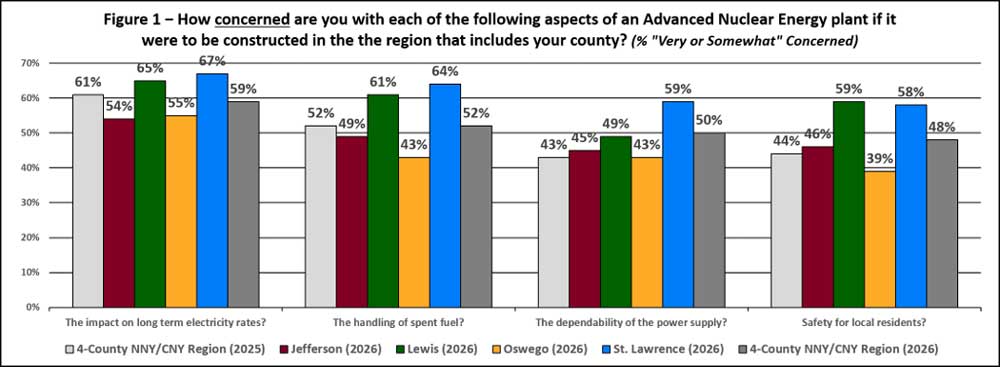
Among four potential concerns that were studied, clearly the aspect of an Advanced Nuclear Energy power plant that continues to be of most concern to Northern and Central NY residents is a pocketbook issue – concern with the impact on long-term electricity rates, with 59% of participants expressing that they are very or somewhat concerned with future rates. One year ago, concern with long term electricity rates was also identified as the greatest concern with a regional rate of 61% rate. Clear differences in level of concerns when comparing the four sampled NY counties emerge in 2026, with residents of Lewis and St. Lawrence Counties expressing the most concerns, and residents of Oswego and Jefferson Counties expressing the least concerns. Levels of concern for the impact on long-term electricity rates (the largest concern expressed) are not significantly different when comparing the two largest political affiliations – for example, among Republicans 42% are very concerned with this affordability aspect, while among Democrats this rate is similarly 43%.
- How important to you are the following considerations with how electricity is produced in the future?
- Affordability of electricity.
- Creating local jobs.
- Preservation of open agricultural land.
- Strengthening the local economic development.
- Reducing emissions.
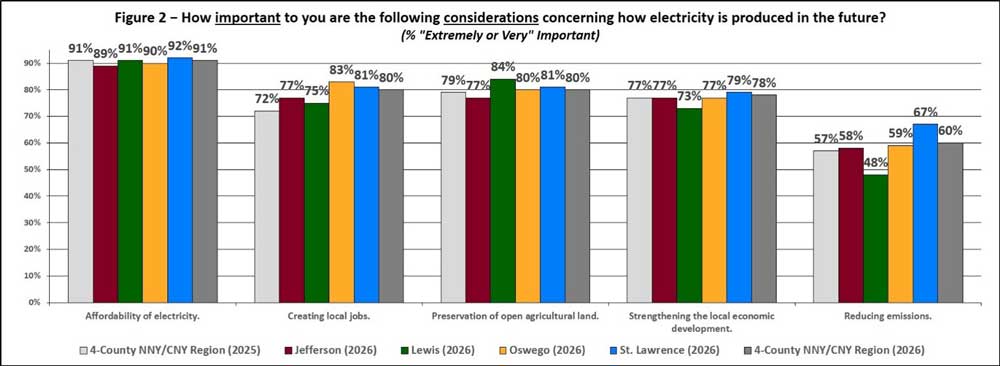
Among five studied considerations, or potential positive impacts, of Advanced Nuclear Energy generation, clearly the aspect of an Advanced Nuclear Energy power plant that continues to be of most importance to residents is a personal economic issue – importance of the future affordability of electricity. A very large 91% of Northern and Central NY participants express that this consideration in 2026 is “extremely or very” important to them (62% respond “extremely”, 28% respond “very”, while only 2% respond either “not too” or “not at all” important). This rate of responding “extremely or very” important is unchanged from 91% found in 2025. The most notable change in attitude regarding these studied considerations is that in 2025 “creating local jobs” was the fourth most important consideration, while one year later in 2026 this consideration has now become the second most important (“extremely or very” important rate increased from 72% to 80% in past year). “Reducing emissions” continues to be of least importance to residents of Northern and Central NY with only 60% responding “extremely or very” important, and particularly low in Lewis County where the rate decreases to only 48%. Perceived importance of the affordability of electricity (the largest perceived importance expressed) is not significantly different when comparing any of the socio-demographic subgroups included in this study, with virtually every subgroup having approximately 90% responding “extremely or very” important. The two largest political affiliations do not differ in perceived importance of electricity affordability – for example, among Republicans 92% perceive this as “extremely or very” important, while among Democrats this rate is similarly 92%.
- Are you familiar enough with Advanced Nuclear Energy technology to confidently know whether you support or oppose the potential future development of these power plants in the North Country (or, “Oswego County”, or “the region of NYS that includes your county”), or do you feel that you need to learn more about the technology and its impacts before you could decide whether you support or oppose?
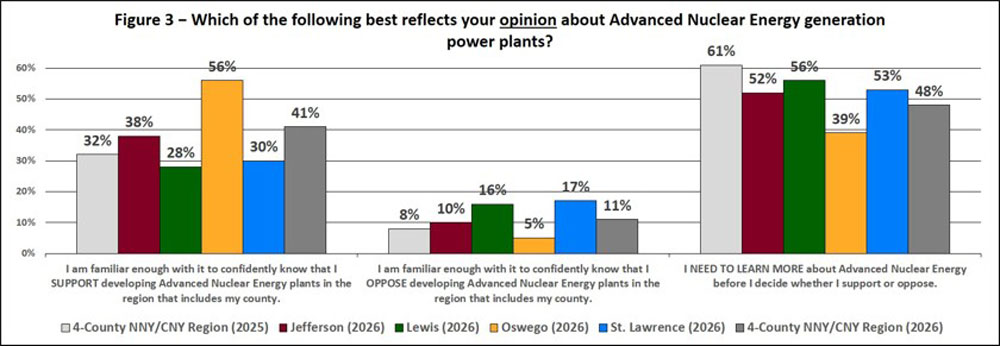
A survey question in this study “Which of the following best reflects your opinion about Advanced Nuclear Energy generation power plants?” has been designed with two goals: (1) identification of the level of desire to learn more about nuclear energy technology, and (2) among those residents who do feel that they know enough about the technology to confidently decide – do they support or oppose potential future development of these power plants in the region that includes their county? Two key findings emerge from the data in 2026. First, in 2025 a majority of adult residents, more than three-in-five in Northern and Central NY (61%) indicated that they felt that they need to learn more before they could confidently decide whether they supported or opposed the future development. This rate has decreased to a minority at 48% one year later. Second, among those who feel that they are well enough informed to confidently decide, it continues to more common that residents are in support rather than in opposition of the development of nuclear power generation plants in the future (by a wide almost 4:1 ratio in Northern and Central NY in 2026, 41% to 11%, respectively, with these rates in the region being 32% and 8% in 2025). Oswego County residents by far express the greatest level of support among the four studied counties (in Oswego County 56% support while only 5% oppose, more than an 11:1 ratio). Beyond this geographic county-specific comparison, it is also of note among every socio-demographic subgroup there is more support for this nuclear plant development expressed than opposition. The subgroups that express the greatest level of support are males (58%), those who self-identify politically as conservative (57%), and individuals from households with annual income of $100,000 or greater (53%). No studied geographic or socio-demographic subgroup had an opposition rate of greater than 20%.
- If an advanced nuclear energy plant were built in your county, do you expect each of the following community factors or characteristics to get better, stay about the same, or get worse in your community?
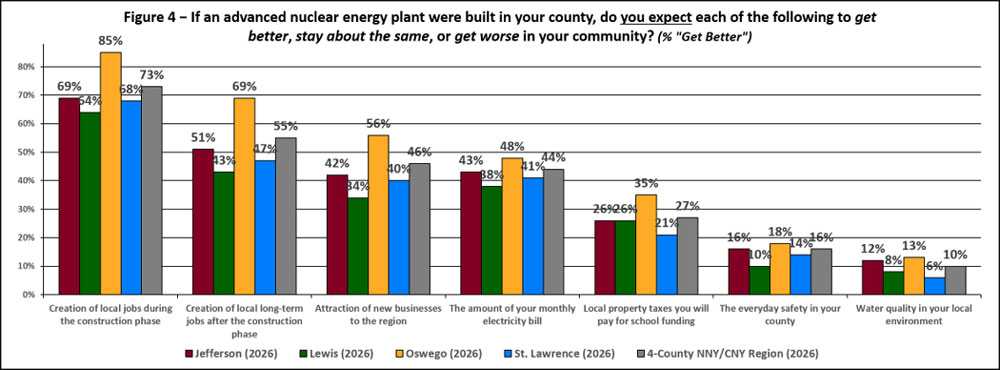
In 2026 for the first time this community research included a set of questions attempting to measure resident expectations if a nuclear plant were built in their county. The two community characteristics that residents most commonly indicate that they expect to get better are job creation related. Almost three-fourths of participants (73%) expect “creation of local jobs during the construction phase” to get better, while a majority (55%) expect “creation of long-term jobs after the construction phase” to get better. Again, Oswego County residents, overwhelmingly, are most likely to express the greatest levels of positive expectations of community impact. Interestingly, in the NNY/CNY region residents are almost twice as likely to expect that “the amount of their monthly electricity bill” will get better rather than get worse (44% versus 24%, respectively, with 19% feeling that these bills will stay about the same). This monthly pocketbook expectation notably has a largest percentage of residents who respond “get better” (as either a plurality or majority response) within every studied socio-demographic subgroup. In other words, the expectation that “the amount of their monthly electricity bill” will get better is common among all residents independent of their socio-demographic characteristics.
- Are you familiar enough with data centers to confidently know whether you support or oppose the potential future development of data centers in the North Country (or, “Oswego County”, or “the region of NYS that includes your county”), or do you feel that you need to learn more about data centers and their impacts before you could decide whether you support or oppose?
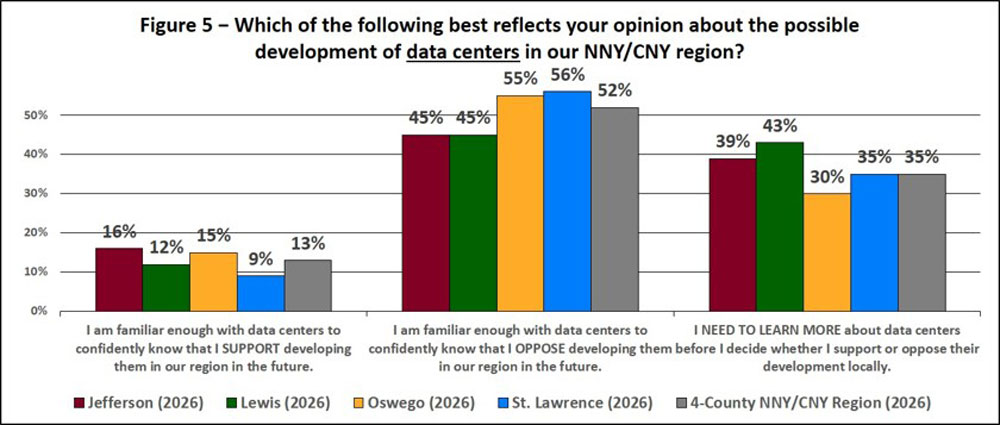
The final survey question in the energy-future section of this annual omnibus survey in 2026 is related to electricity demand rather than generation. The following question has been posed in 2026: “Which of the following best reflects your opinion about the possible development of data centers in the Northern/Central NY region?” Again, this item has been designed with two goals: (1) identification of the level of desire to learn more about data centers, and (2) among those residents who do feel that they know enough about data centers to confidently decide – do they support or oppose potential future development of these data centers in the region that includes their county? Two key findings emerge from the data in 2026. First, approximately two-thirds of residents in Northern and Central NY (65%) indicate that they do not need to learn more before they can confidently decide whether they support or oppose the future development. Second, among those who feel that they are well enough informed to confidently decide, it is much more common that residents are in opposition rather than in support of the development of data centers in their county in the future (by a wide approximately 4:1 ratio in Northern and Central NY, 52% to 13%, respectively). St. Lawrence County residents express the greatest level of opposition among the four studied counties (in St. Lawrence County 56% oppose while only 9% support, more than a 6:1 ratio). Beyond this geographic county-specific comparison, it is also of note among every socio-demographic subgroup there is more opposition for local data center development expressed than support. The subgroups that express the greatest level of support, even though these support levels are still very low, are males (20% support), those who self-identify politically as conservative (20% support), and individuals who are age 60-69 (20% support). Conversely, support levels are tremendously low among Democrats (only 7% support), females (only 6% support), and those individuals who self-identify as a person of color (only 4% support).
Cross-tabulations for this Survey Study
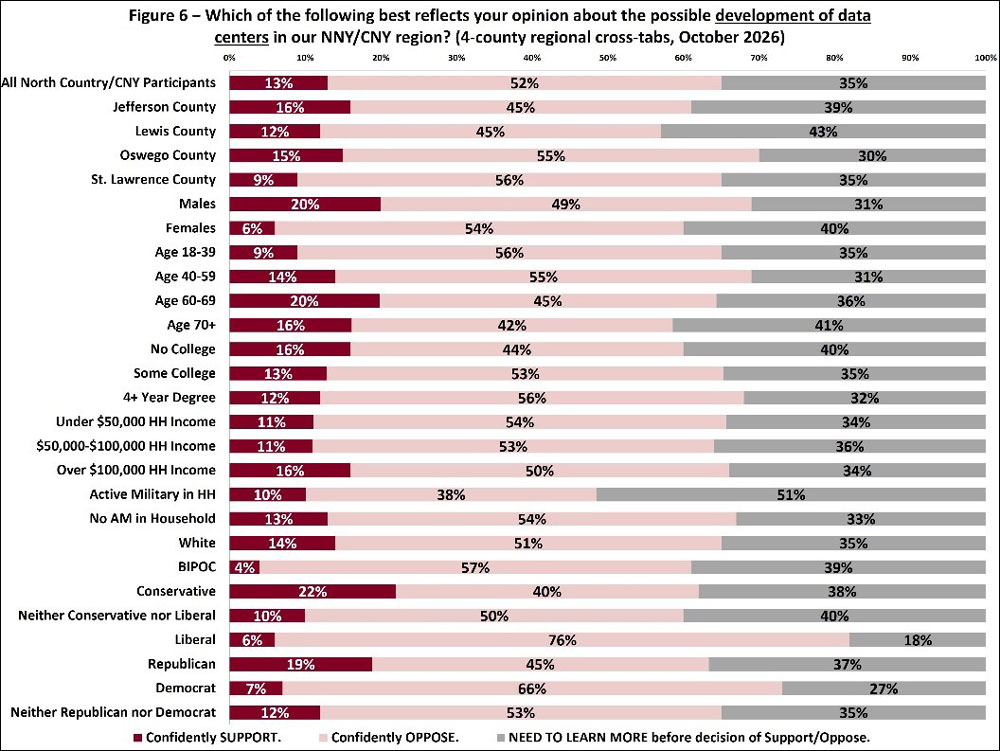
Complete socio-demographic cross-tabulations have been generated for each of the five energy-related survey items previously summarized in the preceding section. The goal of these cross-tabulations is to provide richer correlative data to allow readers to better understand potential explanatory variables that may be associated with energy attitudes and expectations. These cross-tabulations are typically provided in tabular format as standard survey analysis and are included as a separate file appended to this study. Finally, to illustrate the utility of cross-tabulation correlative analyses, the following graph for the 2026 Northern and Central NY study is provided. It is clear that a small minority of residents of the region support development of data centers locally (13%), while a majority (52%) oppose the development. Inspection of the graph shown below (Figure 6), as well as inspection of cross-tabulation Table 5 in the Appendix, illustrate that these attitudes are quite ubiquitous and rather consistent among all studied socio-demographic subgroups. In other words, often-times in our current society, attitudes and behaviors are very polarized among societal subgroups. In particular, polarization due to political ideology and/or political party is now often-times the rule, rather than the exception when researching public opinion. However, this survey item inquiring about data centers shows very similar findings among all studied subgroups, even among the subgroups of political ideology and political party affiliation that commonly have great divides. Among registered Republicans in Northern and Central NY a plurality (45%) indicate that they are in opposition to data center development locally while only 19% are in support. Similarly, among registered Democrats the majority (66%) indicate that they are in opposition to data center development locally while only 7% are in support. Persons associated with each of the two most common political parties agree – both are much more in opposition than in support of local data center development. The current study data suggests that opinion about data centers among Northern and Central New York residents is one of the rare bipartisan agreement topics in our society in 2026.
Methodology Employed for this Study
Between October 26-31, 2026, a mixed-mode sampling method of contact was employed in this study to complete a total of 2,471 interviews of adult residents of a four-county region in Northern and Central New York. Surveys were completed by 769 Jefferson County residents, 609 Lewis County residents, 524 Oswego County residents, and 569 St. Lawrence County residents. Working under the supervision of the Center for Community Studies research staff in a physical call center in Watertown, statistics students enrolled at the College and trained in interview techniques completed 304 live interviews via telephone on both the landline and cellular phones of adult residents. An additional 2,043 surveys were completed online, with 393 via random email invitation and 1,650 via random MMS and SMS text message push-to-web invitations to cellular phones. Finally, 121 intercept surveys were completed at Fort Drum to assist in attaining accurate representation of the military-affiliated subpopulation in the sample collected in this study. After sampling, all data were weighted within-county for gender, age, education, military affiliation, and racial background to ensure representativeness of samples within each county, and when generating aggregate region-wide estimates a further weight for county population sizes was applied. The result of this sampling of 2,471 Northern and Central New York residents is an approximate margin of error of ±2.3% after weighting these sample survey results toward Northern and Central New York population characteristics. County-specific margins of error are approximately ±5% due to smaller within-county sample sizes.
The full report of socio-demographic analyses for each of the future energy landscape survey questions in this study is included as a separate file below:
Future Energy Landscape - Adult Community Survey - Socio-demographic Cross-tabulations
Final Comments and Acknowledgements:
This Northern and Central New York Future Energy Landscape survey has been completed as a subset of the annual omnibus annual survey of the attitudes and opinions of a representative sample of adult residents of the region. This annual survey by the Center for Community Studies has been completed each year in Jefferson County since 2000. The survey expanded to include Lewis County annually in 2007, further expanded to include St. Lawrence County in 2015, and commencing in 2025 has included Oswego County in the regional surveying. The primary goal of the annual survey is to collect data regarding quality-of-life issues of importance to local citizens, and as a result this study provides an annual “snapshot” of life in the region. Additionally, analysis of the 27th Annual Survey data provides an information-rich “motion-picture” of changes in the lives of residents over the past two and a half decades when trends are investigated via comparing with earlier-year results. Over 27,000 interviews that have been completed in a total of 61 county-specific surveys of the community in the four counties since 2000. Typically, the results of this large survey study are released in December, after sampling is completed in October. This year an early release of these Future Energy Landscape survey results is being employed to facilitate their use in the aforementioned public forum to be held at the College on November 12th. The remainder of the longitudinal survey results that have been collected in this omnibus study and an associated full longitudinal report of findings will be released to the public in December 2026.
The sponsors of these annual surveys of the Northern and Central New York communities are Jefferson Community College, CarFreshner Inc., the Northern New York Community Foundation, and the Jefferson and Lewis County Boards of Legislature, who all provide financial support to assist in the funding of these projects.
Related Articles
-
The Center for Community Studies to Release Results of North Country Public Opinion Survey Regarding the Future Energy Landscape and Power Generation in the North Country
For the past two years the Center for Community Studies at Jefferson Community College has surveyed adults regarding electrical energy generation in the future. A key outcome of this local public opinion research has been the prevalent desire expressed by residents to learn more about all factors that impact electricity supply and demand along with facts regarding options available in the future.